
An internal combustion engine or ICE is the main driving unit of the car and can be compared to a human heart in terms of its importance and cruciality to the vehicle. Since it is a mechanical engine, there are a lot of moving parts and mechanical subsystems within the engine that make the vehicle move. Since it is a mechanical entity, it requires lubrication, maintenance, and fuel, and this is the part that we are supposed to discuss: maintenance. When something does go wrong with an engine, you’re supposed to take it to the mechanic, but it doesn’t hurt to know what the details are.
In this blog post, we will look at the complete guide to engine repair, and more specifically, look at timing belts and timing chains, what they do for the engine, and should something go wrong with them, what you are supposed to do then. As you might have guessed, these are both integral parts of the entire engine and should even one of them fail, the entire engine may come to a halt, which is why it’s important to know all you can about these two parts without the need to replace it yourselves.
What is a Timing Belt?
A timing belt, or cambelt, keeps essential components of your car engine (the camshaft and crankshaft) working in sync. The reason the timing belt is so crucial is because any slight disruption to the synchronicity of these components can be disastrous for your car engine. Your engine’s camshaft lets fuel and air in and out of your engine while the crankshaft moves the pistons up and down simultaneously. It’s vital that they work together in perfect harmony. The cambelt ensures the two are always aligned. It’s crucial that you have your cambelt replaced at the manufacturer-recommended interval.
What is a Timing Chain?
A timing chain is essentially the same thing and does the same job as a timing belt, except for the fact that it is a metal chain and not a rubber belt. So, while timing belts are kept in plastic covers in your engine bay to keep them from dust and grime, a timing chain, on the other hand is kept in a sealed compartment and usually shares engine oil to lubricate the chain for smooth, seamless operation. Many older cars use timing chains, and in modern cars, only high-performance vehicles and special engines use timing chains rather than timing belts, owing to their durability and the fact that they are able to withstand sudden surges of power without snapping.
When Do Timing Belts/ Chains Require Repair?
Given that the engine goes through considerable stress and relays much of it to the many parts within itself, it’s no surprise that oftentimes, timing belts may snap off completely or timing chains may snap in two as well, provided that they hadn’t been taken care of in the first place. The fact is that timing belts snap more often, and if you live somewhere cold, the belt gets extremely rigid at times and may snap out of nowhere if the pressure on it gets too much. This is why, it is always advised that whenever you start your car in the cold, during morning or evening, let it sit for a few minutes to let the engine fluids warm up and other components also warm up to allow for smooth, seamless functioning once you actually start driving.
But now, let’s look at engine repair in relation to timing belts and timing chains.
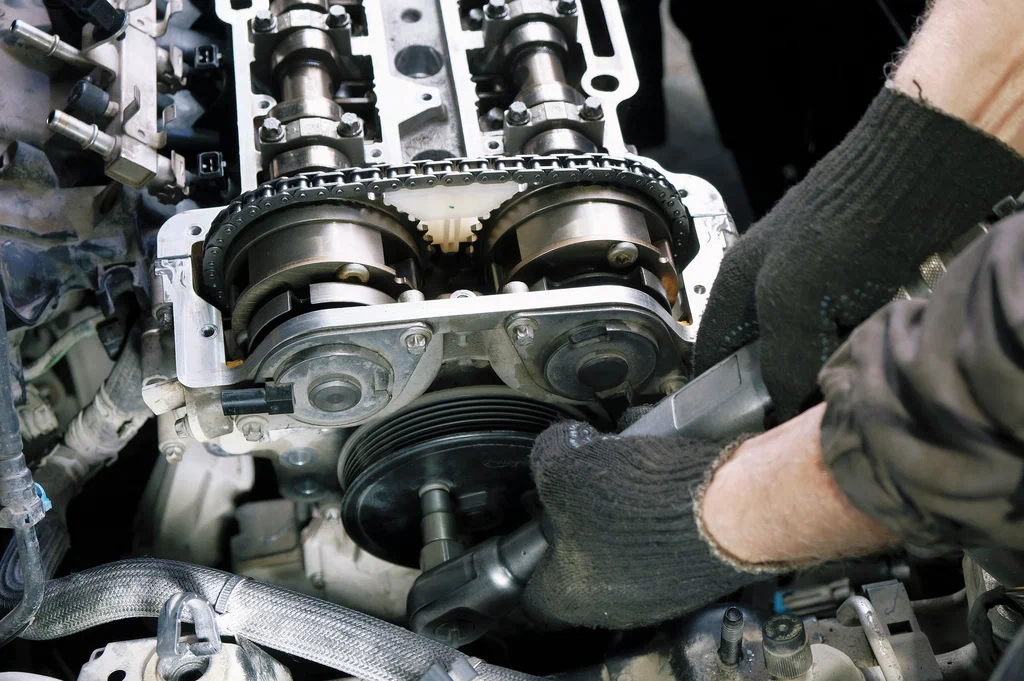
Engine Repair With Timing Belts
While timing belts are very sturdy, there are still times when they might snap, and then your car won’t work at all. However, belts snapping off is not very often, and most of the time, you luckily get signs beforehand of a timing belt that is about to go wrong. Whenever you start your car, and any of the following happens, it usually means that the timing belt is either coming off or may need to be replaced owing to excessive wear and tear. Here are the following signs of a damaged time belt,
- The engine misfires
- A ticking noise coming from the engine
- Oil leaks from the front of the motor
- The engine acts up between 2000 – 4000 RPM
- More smoke and fumes than normal
- The engine won’t turn over
Engine Repair With Timing Chain
While belts are usually more susceptible to damage and wear and tear than chains, that certainly does not mean that chains are invincible or immune to damage. In fact, if the chains are not given enough lubrication, they can mess the engine up much worse than a broken belt will do, not to mention the fact that a timing chain repair or replacement is much more expensive than a timing belt. That also means that as long as your timing chain has sufficient lubrication and isn’t put into extreme stress over extended periods of time, your car’s timing chain will not require overly sophisticated repair or maintenance techniques, and your engine and its output will remain fine.
However, it is important to note here that once you start getting issues with either one of them, whether it’s a timing belt or timing chain, the smart thing to do is to take it to your trusted mechanic, and not attempt anything yourselves. This is because an engine is a complex piece of machinery, and the belts themselves are installed deep within the entire engine, and besides being too complicated, it can also be dangerous since an engine has lots of moving parts and if you don’t know otherwise, you can end up hurting yourself very bad. So, engine repair for both timing chain and timing belts can be done exclusively by a mechanic, but once again, it doesn’t hurt to know about what timing belts and timing chains are, and if you get a specific noise, you know what might be the issue.
Magnum Autoclub: Engine Repair, Maintenance Done Right!
With Magnum Autoclub, vehicle maintenance goes from a burdensome task and chore to a bonding time with your beloved set of wheels. If going from point A to point B was never a joyous task for you, after your car gets the Magnum Autoclub treatment, each drive will be an experience to savour. From complete car care and maintenance to upgrades done without the usual side of hefty bill, Magnum Autoclub is your companion to turn your car into an exquisite machine. Check us out at Magnum Autoclub and feel the difference for yourself.